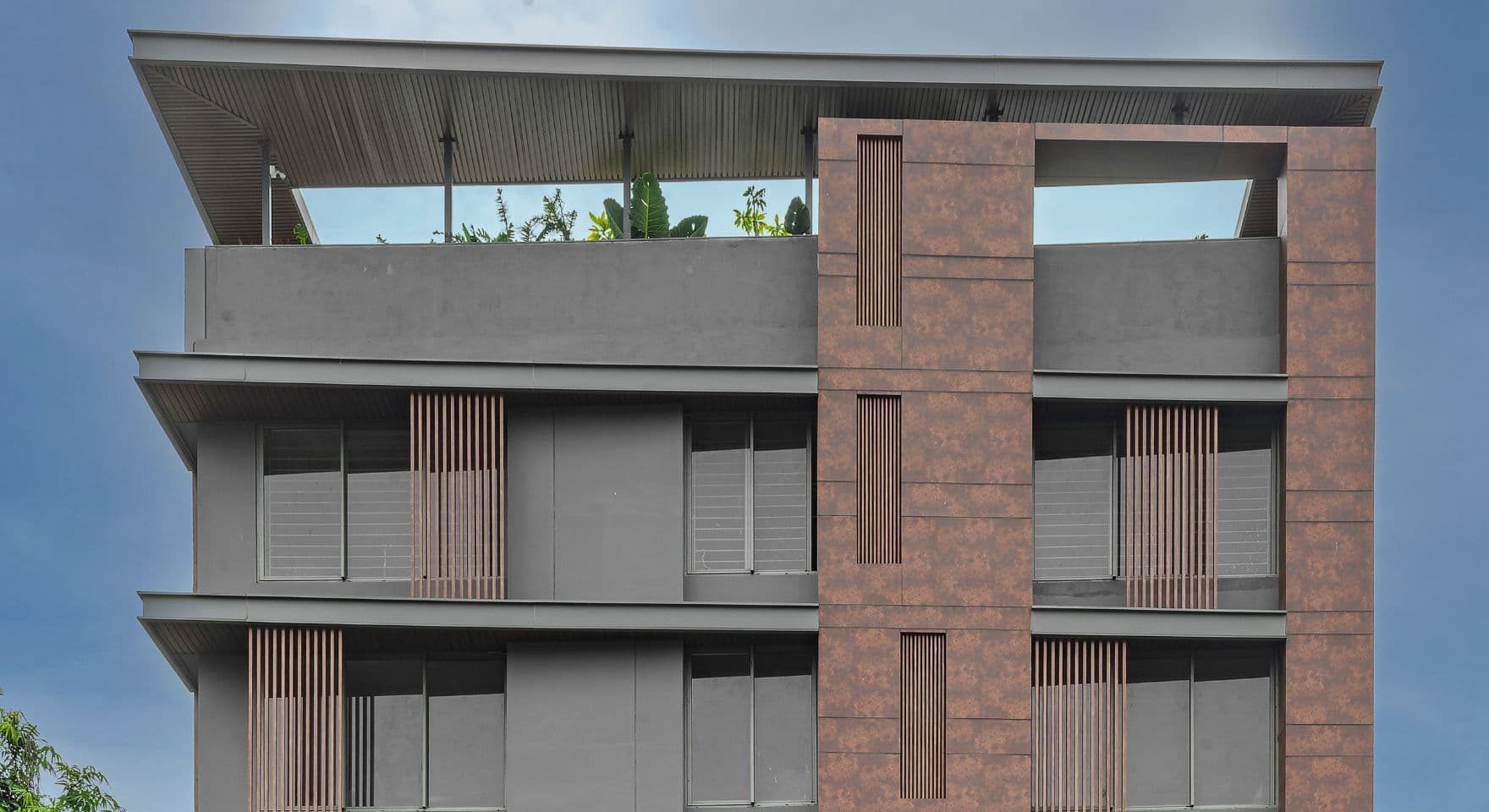
For conservative exterior specifications
We consider PVDF where façade exposure, access difficulty, colour retention and a long-established architectural track record carry more weight than the lowest upfront price.
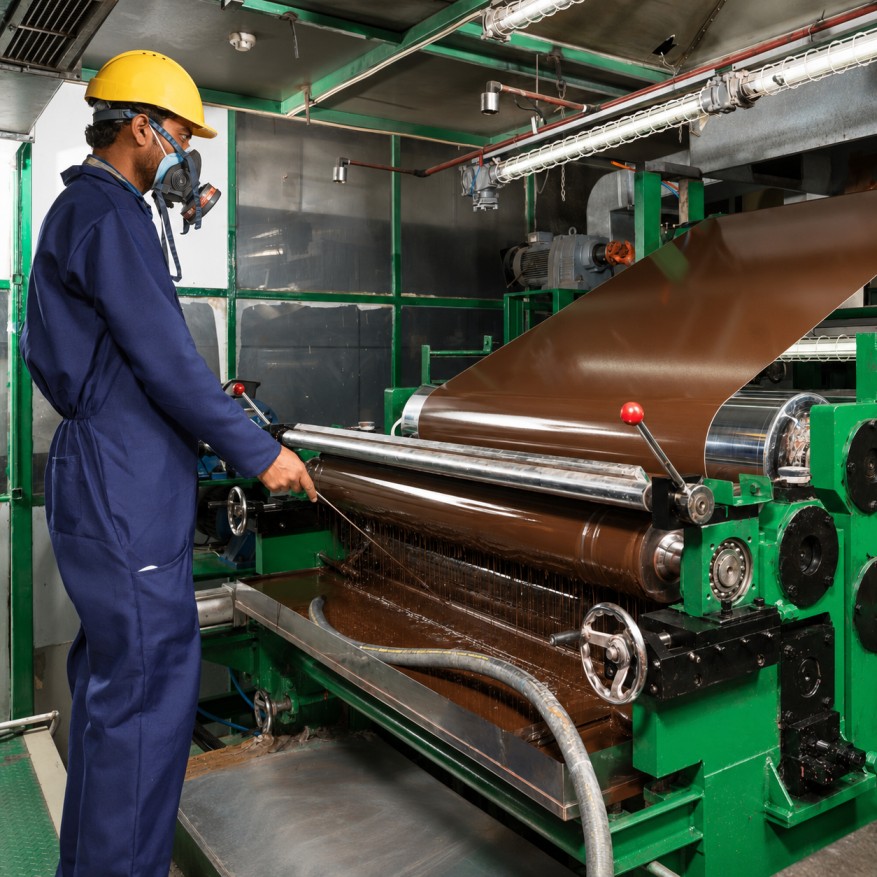
ACP sheet coil coating is the controlled factory process used to clean, pretreat, prime, colour-coat and cure the aluminium coil before it becomes part of an aluminium composite panel. At Aludecor, we treat the finish as a complete paint system—not merely a colour.
PVDF means Polyvinylidene Fluoride, FEVE means Fluoroethylene Vinyl Ether, and SDP means Super Durable Polyester. PVDF and FEVE are premium fluoropolymer families commonly considered for demanding exterior work, while SDP can provide a strong cost-performance balance for moderate exterior exposure. Standard polyester is generally associated with interior use.
The right choice depends on resin chemistry, pretreatment, primer, pigment, topcoat, curing, aluminium substrate, colour, gloss, maintenance access and written warranty. We advise buyers to verify any coating claim—especially a premium coating claim on a very thin aluminium skin—against the product grade, technical data and traceable supply.
We recommend starting with exposure and application, not with the coating name or shade card.
We consider PVDF where façade exposure, access difficulty, colour retention and a long-established architectural track record carry more weight than the lowest upfront price.
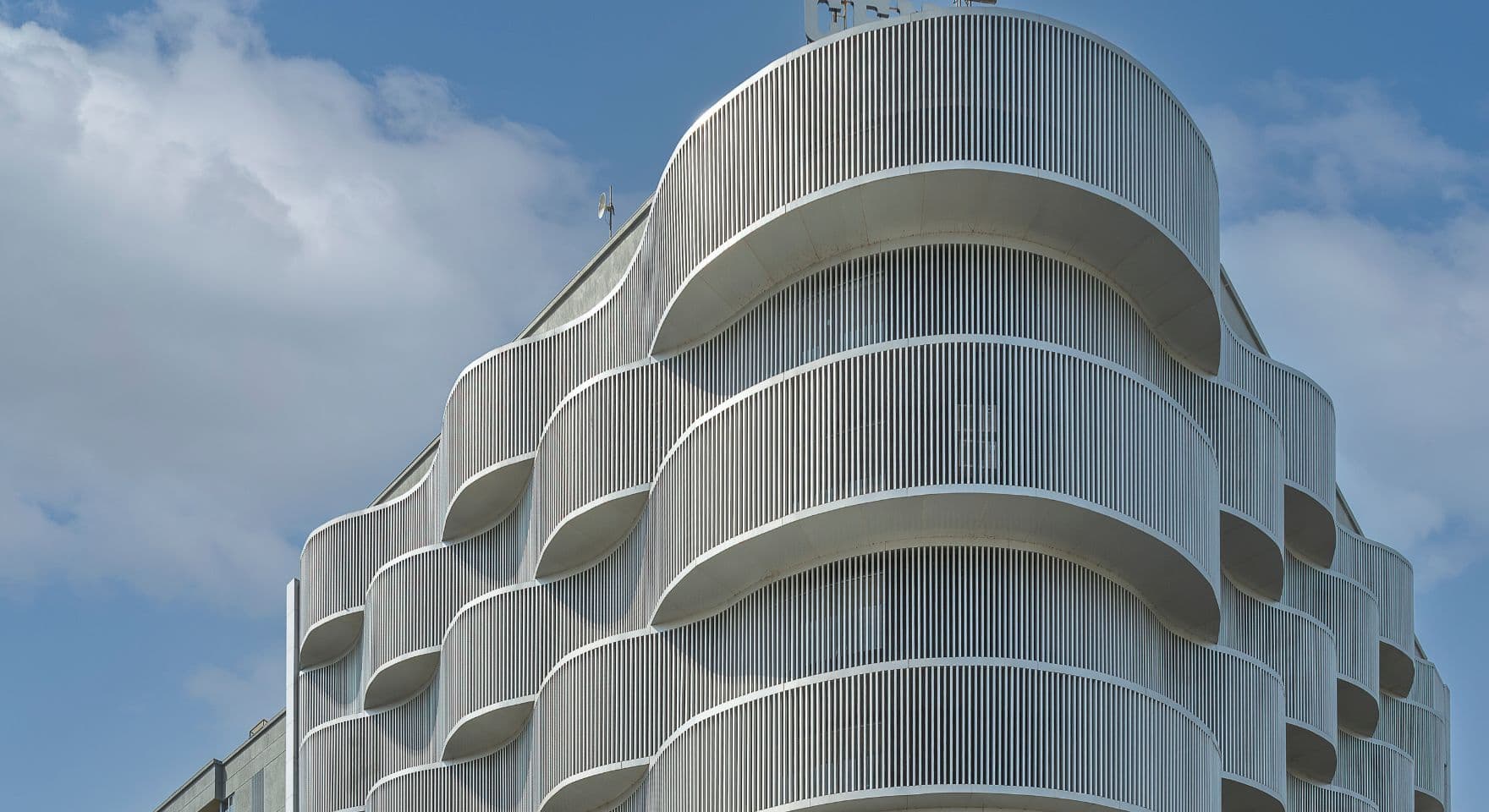
We consider FEVE where a project needs premium exterior weatherability together with wider gloss, vivid colours or special-effect design possibilities.
We consider SDP for moderate exposure, low- to mid-rise applications and budget-conscious exterior work—after checking grade, colour, location and warranty.
ACP sheet coil coating is performed on a continuous aluminium strip before panel lamination. Compared with post-painting a finished part, the process allows controlled surface preparation, repeatable paint application, oven curing, rewinding and in-line inspection.
Not every colour or finish uses the same build. In ACP sheet coil coating, solid, metallic, high-gloss, wood and special-effect finishes may require different coat structures.
We use the full form and resin family as a starting point, then verify the actual primer, coat build, colour, aluminium skin and approved application.
This comparison is application-led. The final decision must be confirmed against the actual Aludecor product grade, approved colour, project location and written warranty.
| Particulars | PVDF | FEVE | SDP | Polyester (PE) |
|---|---|---|---|---|
| Full form | Polyvinylidene Fluoride | Fluoroethylene Vinyl Ether | Super Durable Polyester | Polyester (PE) |
| Resin family | Fluoropolymer | Crosslinkable fluoropolymer | High-performance polyester | Standard polyester |
| Typical positioning | Premium exterior | Premium exterior with design flexibility | Moderate exterior / value-led exterior | Interior / decorative / value-led |
| Exterior suitability | Consider for demanding and hard-to-access façades. | Consider for demanding façades requiring colour or gloss freedom. | Consider for defined moderate exposure and compatible grades. | Polyester grades are positioned for interiors and do not carry an exterior suitability. |
| Colour flexibility | Strong architectural palette; some effects need special coat build. | Broad palette, including vivid and higher-gloss possibilities. | Broad practical palette for general exterior use. | Broad decorative colour possibilities for approved interior grades. |
| Gloss possibilities | Often selected in controlled architectural gloss ranges. | Generally offers wider gloss flexibility. | Good practical gloss options; confirm shade and finish. | Decorative gloss options are available; gloss should not be treated as evidence of exterior durability. |
| Weathering tendency | Strong long-term exterior potential when the complete system is correct. | Strong exterior potential with premium design freedom. | Good moderate-exposure performance; harsher exposure needs careful review. | Lower exterior weathering resistance than SDP and fluoropolymer systems; use within approved interior applications. |
| UV and chalk resistance | High potential in a verified architectural system. | High potential in a verified architectural system. | Higher than standard polyester but generally below premium fluoropolymers. | Lower than SDP, PVDF and FEVE; Polyester grades are not positioned for exterior exposure. |
| Fabrication | Depends on alloy, temper, DFT, curing and routing. | Depends on the complete system and approved fabrication guidance. | Depends on film integrity, curing and substrate. | Depends on film integrity, curing and the thin aluminium substrate used in the approved interior grade. |
| Price tendency | Premium | Premium | More economical than premium fluoropolymers in many specifications | Generally economical / value-led |
| Warranty tendency | Longer warranties may be available on selected grades and colours. | Project- and product-specific; confirm current written terms. | Defined exterior warranties may be available on selected grades and colours. | Current Polyester grades have no exterior warranty. |
| Main buyer caution | Do not accept the label without grade, skin, DFT and warranty evidence. | Confirm actual product availability, approved colours and system data. | Do not confuse it with standard polyester or overextend its exposure category. | PE here means Polyester coating. Do not confuse it with the polyethylene/LDPE core, and do not assume an interior Polyester finish is suitable outdoors. |
Grade references: Polyester on our AL312 and AL32 interior grades at 15–18 microns with no exterior warranty. Selected SDP grades are listed at 25–28 microns with 10-year warranties, while selected PVDF grades are listed at 25–28 microns with 15-year warranties. FEVE and any 30–35 micron / three-coat terms should be confirmed with us against the current product, colour, and written quotation or warranty. These are our grade-level references, not a universal promise for every shade, finish, location, or project.
We do not declare one universal winner. We identify the coating that best fits exposure, appearance, access, budget and the approved product grade.
PVDF may be preferred for a conservative, widely recognised architectural specification. FEVE may be preferred when premium weatherability must be paired with broader gloss, brighter colour or special-effect capability.
PVDF is generally considered for more demanding exterior risk and difficult future access. SDP can be sufficient for moderate exterior exposure when the building, grade, colour and maintenance plan are compatible.
FEVE offers a premium fluoropolymer route for expressive colours and gloss. SDP offers a practical value route for moderate exterior work. Both require documented system data and shade-specific warranty review.
A resin label is only one part of coating quality on ACP. Our technical teams evaluate the complete ACP sheet coil coating process and the finished product.
Binder quality, pigment stability and compatibility affect colour, gloss and weathering.
Cleaning and pretreatment influence adhesion and long-term film integrity.
The primer must suit the aluminium substrate and topcoat system.
DFT, colour and gloss consistency must be controlled across the coil and batch.
Incomplete or inconsistent curing can affect adhesion, hardness and fabrication.
Traceability helps match approved samples, production identity and supplied material.
Routing, bending and rolling depend on coating, alloy, temper and panel construction.
Protective film and storage affect delivered appearance but are not the coating itself.
Adhesion, DFT, gloss, weathering and written exclusions complete the evidence.
ACP sheet coil coating should be verified through the complete product identity and evidence trail—not by a brochure line alone.
The coating influences the exposed surface, but it does not independently decide the entire panel’s performance.
The Best ACP sheet core depends on fire strategy, occupancy, building height, application and project requirements. The coating system is selected for surface exposure, colour, finish, weathering, maintenance and warranty. A premium PVDF coating does not make a combustible or unsuitable core appropriate for a fire-sensitive façade. Equally, a fire-retardant core does not compensate for an interior-grade coating used outdoors. We evaluate coating, core, skin thickness, alloy, panel thickness, grade and installation together.
Weathering, colour, gloss, cleaning and warranty.
Fire behaviour, density, fabrication and classification potential.
Rigidity, flatness, strength, fabrication and cost.
Wind load, joints, drainage, cavity barriers and approvals.
We use application, exposure, design intent and maintenance access to shortlist the coating family.
This matrix is a screening tool, not a specification substitute. We confirm the final coating and grade against project documents.
| Project type | Coating to consider | Why | Important checks | Warranty question |
|---|---|---|---|---|
| Interior wall cladding | Polyester / decorative system | Limited weather exposure | Cleaning, impact, finish, fire requirements | Is the finish approved for this interior use? |
| Retail interiors | Polyester, SDP or special finish | Colour and cleaning are key | Scratch visibility, batch and replacement access | What surface defects or cleaning methods are excluded? |
| Outdoor signage | SDP, PVDF or FEVE | Brand colour and UV exposure | Skin thickness, flatness, colour, print/vinyl system | Is brand colour covered at the project location? |
| Low-rise exterior | SDP or premium fluoropolymer | Exposure can range from moderate to severe | Height, wind, UV, pollution and access | Is the selected grade and colour covered? |
| Commercial façade | SDP, PVDF or FEVE | Risk depends on height and exposure | Alloy, skin, core, coat build and maintenance | What are the location and cleaning exclusions? |
| High-rise façade | PVDF or FEVE | Access difficulty and long-term exposure | Façade engineer review, grade, wind and fire strategy | Is high-rise application explicitly covered? |
| Canopy | SDP, PVDF or FEVE | Strong directional weathering and runoff | Top/bottom visibility, drainage and edge detailing | Are horizontal or near-horizontal surfaces covered? |
| Soffit | SDP, PVDF or FEVE | Often sheltered but pollution-prone | Moisture, cleaning and colour continuity | Does the warranty cover the actual orientation? |
| Parapet | PVDF or FEVE; SDP where approved | High UV and water exposure | Capping, runoff, joints and maintenance | Are parapet and horizontal zones included? |
| Corporate identity project | PVDF or FEVE; SDP for moderate exposure | Colour consistency is business-critical | Master sample, gloss, batch and replacement strategy | Is the exact corporate shade covered? |
| High-gloss decorative use | FEVE or approved special system | Broader gloss and colour possibilities | Scratch visibility, clear coat, sample and fabrication | Is high gloss covered without special exclusions? |
| Wood or special-effect finish | Approved multi-coat or effect system | Finish construction may differ from solid colour | Clear coat, pattern repeat, direction and batch | What part of the effect appearance is warranted? |
| High-UV location | PVDF or FEVE | Higher weathering demand | Pigment, colour, orientation and maintenance | Is high-UV exposure addressed in writing? |
| Coastal or industrial location | Project-specific PVDF or FEVE system | Aggressive environment and difficult maintenance | Substrate, edges, fixings, cleaning and consultant review | What coastal, industrial or pollution exclusions apply? |
Several important coating variables are not obvious from a shade card or a newly delivered sheet.
Primer, pretreatment, pigment, coat build, curing and aluminium substrate can change performance within the same broad resin family.
Colour, gloss, effect, location and orientation can change written terms and exclusions.
Handling, flatness, tension, curing and rewinding become more demanding as the aluminium skin becomes thinner.
Metallic, wood, high-gloss or bright effects may use a clear coat, additional coat or different approved system.
It protects the surface temporarily and must be handled and removed as directed; it is not part of the paint warranty.
Long-term coating quality requires evidence on adhesion, DFT, gloss, weathering, batch identity and maintenance.
We see coating decisions fail when a colour name or low rate replaces a complete specification.
Corrective action: approve colour, gloss, texture, resin family, coat build and grade together.
Corrective action: verify resin declaration, primer, DFT, aluminium skin, TDS, warranty and traceability.
Corrective action: measure and document both skins; do not rely only on total panel thickness.
Corrective action: request the complete paint-system description and adhesion evidence.
Corrective action: obtain shade-, finish- and location-specific written terms.
Corrective action: normalise coating, skins, alloy, core, grade, warranty and commercial scope.
Corrective action: inspect coating documents separately and follow film-removal instructions.
Corrective action: select coating and core independently against exposure and fire strategy.
Corrective action: request technical evidence, DFT, grade, warranty and batch identity.
Corrective action: confirm exterior approval, exposure suitability and written warranty.
Corrective action: plan quantities, use one batch where practical and follow protective-film arrows.
Corrective action: retain the TDS, approved sample, test evidence, warranty, invoice and delivery labels.

Share your project location, height, application, colour, finish, gloss, aluminium skin, core, panel grade, quantity and warranty expectations. We can help you shortlist the right coating family and the documents to verify.
These answers summarise the technical checks buyers, architects, dealers, fabricators and project teams should make before approval.