Ask for the exact class, smoke category and droplet category.
Fire-safety education guide
What Is an FR ACP Sheet?
An FR ACP sheet is an aluminium composite panel designed with a core intended to improve reaction-to-fire performance compared with a conventional combustible-core ACP. FR usually means fire-retardant, but it does not automatically mean fireproof, non-combustible or approved for every façade. Fire-resistant ACP sheets must be evaluated through the exact product composition, reaction-to-fire classification, smoke and droplet classes, test evidence, installation system and project conditions.
Fire-resistant ACP sheets can carry classifications such as B-s1,d0 or A2-s1,d0 under EN 13501-1. In A2-s1,d0, A2 relates to limited contribution to fire, s1 relates to low smoke production and d0 relates to the absence of flaming droplets or particles in the relevant test. This classification applies to the tested product; it is not automatic approval for the entire façade assembly or every high-rise project.
Before specifying FR ACPs, buyers should request the technical data sheet, full test and classification reports, tested thickness and skin details, product identity, core declaration, traceability records, fabrication guidance and any required façade-system evidence. Qualified architects, façade consultants, fire consultants, engineers and approving authorities should review project-specific suitability.
Quick summaryFR is not a complete classification A2-s1,d0 is reaction to fire The façade is a system Documents must match supply
What should you know before specifying FR ACP?
It does not provide a structural fire-resistance duration.
Panel, insulation, cavities, barriers, fixings and workmanship interact.
Verify product identity, thickness, skin, core, report scope and traceability.
Definition and construction
What does FR ACP mean?
FR ACP commonly refers to an aluminium composite panel with a mineral-filled core or otherwise modified core formulated to reduce fire contribution compared with a conventional polyethylene-rich core. The panel generally consists of two aluminium skins, a central core, bonding layers, a coated decorative face and a removable protective film.
Fire-resistant ACP sheets are not one uniform product class. Products can differ in core chemistry, mineral content, smoke production, flaming-droplet behaviour, total thickness, aluminium skin, coating, intended application and independent test evidence. The broad term “FR” therefore needs to be followed by a formal classification and product-specific documents.
Fire-resistant ACP sheets should also be distinguished from “fire resistance” of an assembly. A reaction-to-fire class explains how the tested material behaves when exposed to fire; it does not state that a wall or façade will maintain integrity or insulation for a specified number of minutes.
General FR ACP layer structure
- Removable protective film used during handling and fabrication.
- Decorative and protective coating selected for the intended exposure.
- Outer aluminium skins whose specification must match the test report.
- Mineral-filled or higher-inorganic core designed for improved fire performance.
- Bonding system and rear service coat forming the composite panel.
Material comparison
FR ACP vs Standard ACP
Fire-retardant ACP is intended to reduce fire contribution compared with conventional combustible-core ACP, but the exact performance must be read from the applicable test and classification reports rather than inferred from an “FR” label.
| Particular | Non FR ACP Sheets | FR ACP Sheets |
|---|---|---|
| Core approach | Typically contains a higher proportion of combustible polymer. | Uses a modified or mineral-filled core to improve fire behaviour. |
| Reaction to fire | May contribute more readily to heat and flame spread, depending on the tested product. | Designed for lower fire contribution; the exact class must be verified. |
| Smoke and droplets | May show higher smoke or flaming-droplet risk, depending on classification. | Smoke and droplet behaviour are stated separately as s and d classes. |
| Documentation | May have limited fire-performance evidence where no class is claimed. | Should be supported by a full test report and classification report. |
| Façade selection | Requires careful project review and may be unsuitable for risk-sensitive applications. | Still requires façade-system review, cavity design and professional approval. |
| High-rise selection | Combustible façade materials are increasingly avoided in high-risk and high-rise applications. | The exact class and system evidence must meet project and authority requirements. |
| Commercial effect | Material cost may be lower. | Testing, mineral core, traceability and manufacturing controls can increase cost. |
Classes and grades
How are FR ACP classes and grades interpreted?
Terms such as FR, mineral-filled, Class B and A2 are not interchangeable. “FR” is a broad market label; EN 13501-1 classifications such as B-s1,d0 and A2-s1,d0 are formal reaction-to-fire results for a defined tested product.
Conventional combustible-core ACP
Usually relies mainly on polymer in the core. Buyers should not assume façade suitability without formal fire-performance evidence.
Fire-retardant or Class B ACP
Commonly uses a mineral-filled core and may achieve B-s1,d0 when the tested product meets the relevant criteria. Under the Euroclass hierarchy, B represents very limited contribution to fire. The term FR alone is insufficient.
FR A2 ACP
An A2-classified panel is designed to meet the more stringent A2 criteria, corresponding to no significant contribution to fire development within the Euroclass framework. Its exact report, specimen construction and field of application must match the supplied material.
Important: Mineral percentage is useful product information, but it is not a substitute for a classification report. Core chemistry, complete specimen construction and test results determine the stated class.
A2-s1,d0 explained
What does A2-s1,d0 mean?
A2-s1,d0 is a reaction-to-fire classification. It describes the tested product’s contribution to fire, smoke production and flaming droplets or particles. It does not mean the product is fireproof, does not provide a structural fire-resistance duration and does not automatically certify the complete façade assembly.
A2
No significant contribution to fire development within the EN 13501-1 Euroclass criteria. A2 should not be simplified as A1-level non-combustibility, “fireproof”, or universal approval.
s1
The lowest smoke-production category in the classification framework. It means restricted smoke production under the test criteria, not guaranteed zero smoke in every real fire.
d0
No flaming droplets or particles observed during the relevant test period. It does not eliminate all façade or fire hazards.
Reading the notation
ACP fire classification: what each result proves
| Classification element | What it measures | Meaning of the stated class | What it does not prove | Document to verify |
|---|---|---|---|---|
| Main class | Contribution to fire and combustibility within the classification framework. | A2 indicates no significant contribution to fire development under the applicable Euroclass criteria; B indicates very limited contribution. | It does not provide a fire-resistance duration for a wall or façade. | Full classification report and underlying test reports. |
| Smoke class | Smoke production during the relevant test. | s1 is the lowest smoke-production category; s2 and s3 indicate progressively less restrictive smoke performance. | It does not guarantee zero smoke or zero toxicity in every fire scenario. | Classification report showing the s category. |
| Droplet class | Occurrence of flaming droplets or particles. | d0 means no flaming droplets or particles in the relevant test period. | It does not certify the safety of cavities, insulation or adjacent components. | Classification report showing the d category. |
| Panel-level result | Performance of the tested product specimen. | Applies to the product and field of application described in the report. | Does not automatically cover every thickness, skin, finish, fixing or installation. | Specimen description, report scope and field of application. |
| System-level evidence | Behaviour of an assembled façade build-up where a system test is required. | Can account for panel, insulation, cavity, barriers, sub-frame and fixings in the tested arrangement. | Does not automatically cover untested substitutions or workmanship changes. | Relevant full-scale system report and project approval. |
Two different concepts
Reaction to fire Vs fire resistance
Reaction to fire describes how a material contributes to ignition, heat release, flame spread, smoke and flaming droplets when exposed to fire. A2-s1,d0 and B-s1,d0 are reaction-to-fire classifications.
Fire resistance describes how an element or assembly maintains functions such as integrity, insulation or load-bearing capacity for a specified period under defined test conditions. A reaction-to-fire class must not be converted into a number of minutes or hours of fire resistance.
Fire-resistant ACP sheets may form part of a fire-safety strategy, but the complete wall or façade assembly must be assessed for the performance required by the project.
Do not read A2-s1,d0 as a time rating
The notation does not mean “two-hour fire resistance.” Any required fire-resistance period must be supported by an appropriate assembly or element test and must match the actual construction.
Higher fire-performance category
FR A2 ACP: what buyers should verify
FR A2 ACP is a mineral-rich aluminium composite panel category designed to achieve an A2 reaction-to-fire classification. Compared with Class B and lower fire-performance categories, it is designed to make a smaller contribution to fire. The buyer should verify the complete A2-s1,d0 classification rather than relying on the words “A2 core”, “FR”, or a mineral percentage alone.
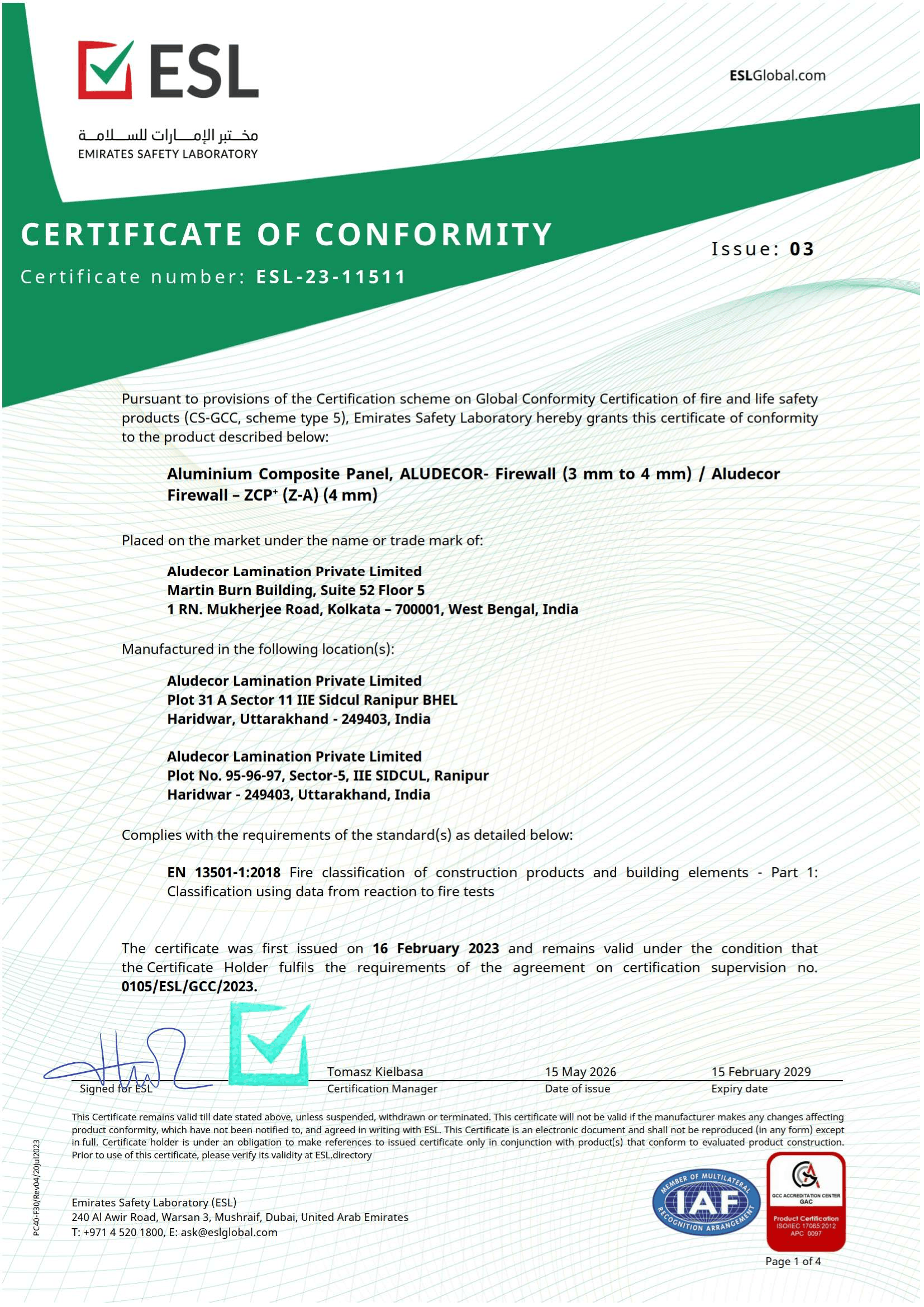
For our Firewall A2, the core contains more than 90% mineral content and the product is process-certified by Emirates Safety Laboratory (ESL), Dubai, to EN 13501-1 Class A2-s1,d0. Our Firewall Class B is process-certified by ESL to EN 13501-1 Class B-s1,d0. These are product-level reaction-to-fire classifications, so project teams should still verify that the supplied panel matches the certified construction and that the façade build-up meets project requirements.
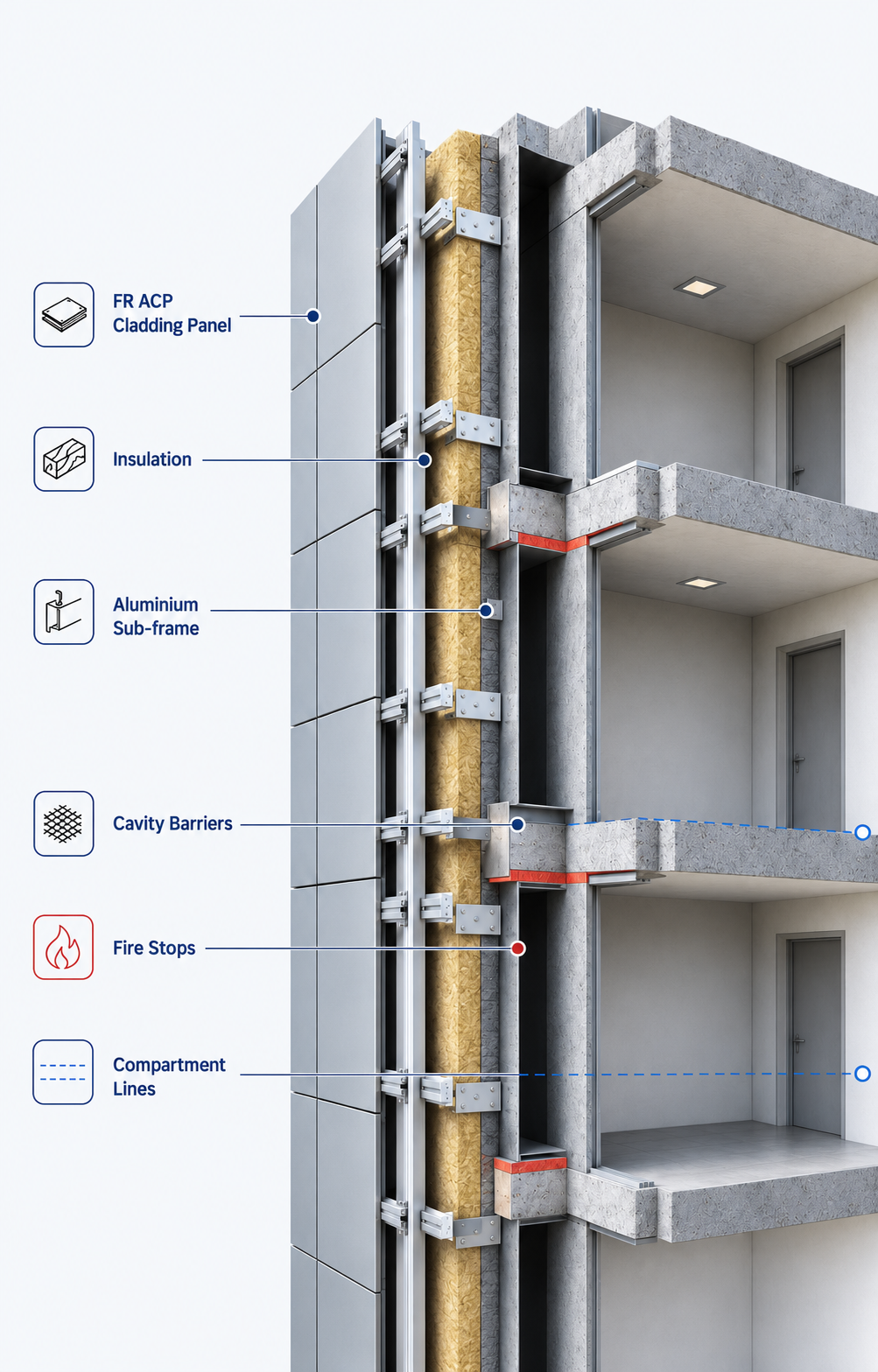
An A2 panel classification does not automatically make the complete façade A2. The insulation, membranes, cavity barriers, sub-frame, fixings, sealants and interfaces remain part of project-specific system evaluation.
Questions to ask about FR A2 ACP
- Is the formal result A2-s1,d0?
- Does the tested thickness match the supply?
- Do aluminium skin and core descriptions match?
- Is the report issued by a competent accredited laboratory?
- Does the report cover the intended mounting and use?
- Is separate façade-system evidence required?
FR is a broad label
Fire-retardant ACPs and core types
Fire-retardant ACPs can include multiple core formulations and performance levels. Two products both marketed as “FR” may have different mineral content, polymer chemistry, smoke production, droplet behaviour and formal classifications. Mineral-filled FR cores commonly use heat-absorbing fillers such as magnesium hydroxide (MDH) and aluminium trihydrate (ATH); their endothermic decomposition can absorb heat and release water vapour. Core formulation alone, however, does not establish a Euroclass.
Core composition
A mineral-filled core is generally used to reduce combustible content and absorb heat, but composition alone does not prove a classification.
Formal result
The full class, including smoke and droplet suffixes, is more informative than the FR label or a grade name.
Installation discipline
Fabrication, routing, fixing and site substitution must follow approved product and project guidance.
When selecting a fire-retardant material, check product identity, core type, reaction-to-fire class, test laboratory, certificate scope, panel thickness, aluminium skin, coating, intended use, installation system and consultant approval.
205 Tests / Test Nahi Toh Trust Nahi
Fire-safety claims must be tested, not assumed
Our 205 Tests quality framework reinforces a simple principle: performance claims should be supported by measurable evidence. For fire classification, however, the 205 Tests framework is not a substitute for the accredited fire-test and classification documents applicable to the exact product. A brochure statement such as “FR”, “A2” or “fire-safe” is only the starting point; buyers should verify the product identity, applicable test method, classification report and whether the material delivered to site matches the tested construction.
Fire-related evaluation of ACP can examine how a panel reacts when exposed to heat and flame, how much heat it releases, whether fire propagates, how much smoke is produced and whether molten or flaming droplets occur. Where a fire-resistance or system test is applicable, integrity, temperature rise, attachment and behaviour under hose-stream or full-assembly conditions may also be assessed.
Checks whether the tested product contributes to flame travel under the specified method.
Measures the energy or heat contribution that can intensify a developing fire.
Evaluates smoke behaviour because visibility and evacuation can be affected before flames reach occupants.
Observes whether burning material can fall and create secondary ignition risk.
Confirms that thickness, aluminium skins, core composition and supplied product match the tested sample.
Reviews the installed build-up where project requirements extend beyond panel reaction-to-fire classification.
Important: the applicable tests depend on the product, classification standard and intended use. Test reports should be read together with product traceability, façade details, cavity barriers, fire stops, installation quality and professional approval.
Join the Movement
Test the ACP panel supplied at your project site
Big fire-safety claims should stand up to independent verification. Arrange testing of an ACP sample taken from the actual project-site stock – not only a showroom swatch or marketing sample—and compare the result with the declared product grade, core type and fire classification.
Keep the invoice, batch details, protective film, product label and declared test documents with the sample. This helps establish whether the material supplied to the project is consistent with the product that was promised.
Project-site sample testing strengthens due diligence. It does not replace façade-system evaluation, statutory approval or advice from the architect, façade consultant, fire consultant and approving authority.

Fire-safety for high-rises
Why high-rise façade selection requires system-level thinking
Fire-safety for high-rises cannot be reduced to choosing a panel labelled FR. Building height, occupancy, evacuation complexity, fire-brigade access, cavity geometry, window interfaces, insulation, membranes, sub-frame, fixings, sealants, barriers, fire stops and installation quality all influence risk.
FR ACP used in high-rise façade cladding should be reviewed against NBCS 2026, the applicable state/local regulations, the project’s required reaction-to-fire class, façade-fire test requirements, authority expectations and any required full-scale system evidence. The supplied product must match the tested and approved specification throughout procurement and installation.
Fire-safety for high-rises also depends on traceability. Site teams should be able to identify the panel, core, batch, thickness and approved façade details. Substituting a visually similar panel or changing an insulation, barrier or fixing can invalidate the design basis.
High-rise review checklist
- Building height and occupancy
- Evacuation and rescue conditions
- Required panel and system classifications
- Cavity geometry and barrier locations
- Insulation and membrane combustibility
- Windows, openings and slab-edge interfaces
- Sub-frame, brackets and fixings
- System evidence and consultant approval
- Installation inspection and traceability
Test-report verification
How to read an ACP fire test report
A test report should be read as a technical scope document, not as a badge. Verify that the tested specimen is the same product being specified and supplied.
- Confirm product name and manufacturer.
- Check core description and product identity.
- Verify total panel thickness.
- Verify aluminium skin specification.
- Check coating or finish description.
- Identify the test standard.
- Read the complete classification result.
- Check smoke and droplet classes.
- Confirm the laboratory, accreditation scope, and where FPC or product certification is claimed.
- Record report or certificate number and date.
- Review specimen construction and mounting.
- Read field of application and limitations.
- Check whether the supplied product and batch are traceable.
- Confirm whether system-level evidence is also required.
Documentation
Certificate Section
Fire-resistant ACP sheets should be supported by a coordinated document set. No single brochure, certificate or test result proves complete project compliance.
- Technical data sheet and complete product specification
- Reaction-to-fire test and classification reports
- Core-composition declaration and product identity
- Current FPC or product-certification evidence, where claimed or required
- Batch or product traceability information
- Fabrication and installation guidance
- Relevant system-test report, where required
- Cavity-barrier, fire-stop and sub-frame details
- Approved shop drawings and consultant approval
- Project-required warranty and compliance documents
Application guidance
Where can FR ACPs be evaluated?
Exterior façades
Review panel class together with building height, occupancy, cavity design, insulation, membranes, sub-frame, fixings, joints, barriers, windows and local requirements.
High-rise buildings
High-rise fire-safety review may require façade-system evidence in addition to panel classification, together with consultant review, authority approval, installation inspection and traceable supply.
Interiors and escape routes
Wall cladding, ceilings, partitions, lift lobbies, corridors, retail, hospitality and healthcare areas can have different fire and smoke requirements based on occupancy and location.
Transport and institutional projects
Airports, metro stations, railway facilities, terminals, hospitals, schools and public buildings require project-specific classification and documentation checks.
Price and project cost
Why can Fire-resistant ACP sheets cost more?
Fire-resistant ACP sheets may cost more than conventional combustible-core ACP because of mineral-rich core materials, manufacturing control, independent testing, classification, documentation, traceability, aluminium skin, coating, panel thickness, order quantity and freight. The complete project cost may also include specialised fabrication, sub-framing, fixings, cavity barriers, fire stops, installation, inspection and engineering.
The lowest-priced FR quotation should not be assumed to offer equivalent performance. Compare the exact classification, tested construction, documents, product identity, delivery scope and installed-system requirements on a like-for-like basis.
Category comparison
Standard ACP vs FR ACP vs A2 ACP
| Particular | Standard ACP Sheets | FR ACP Sheets | A2 ACP Sheets |
|---|---|---|---|
| General core approach | Higher combustible polymer content. | Mineral-filled core intended to reduce fire contribution. | Higher-inorganic-content core formulated to meet the more stringent A2 reaction-to-fire criteria. |
| Formal class | Varies; may be lower or unclassified. | May achieve B-s1,d0 when the tested product meets the criteria. | May achieve A2-s1,d0 when the tested product meets the criteria. |
| Smoke and droplets | Must be read from the report; may be less restrictive. | Can include s1 and d0 where formally classified. | Can include s1 and d0 where formally classified. |
| Typical documentation | Technical data and any available test evidence. | Full reaction-to-fire and classification reports. | Full A2 classification, underlying tests and matching product details. |
| High-rise consideration | For external façades, a conventional combustible core does not satisfy the NBCS 2026 condition of a minimum 70% mineral core where ACP is used. | Requires project review, the applicable façade-fire tests and any system evidence required by the approving route. | Provides higher reaction-to-fire performance, but still requires NBCS 2026, local-regulation and façade-system review. |
| Need for system evidence | Yes, where the project requires it. | Yes, where the project requires it. | Yes; A2 panel classification does not certify the assembly. |
| Main caution | Do not select only by price or appearance. | Do not treat the broad FR label as a complete classification. | Do not treat A2-s1,d0 as fireproof or universal approval. |
Indian fire and life safety expectations
NBCS 2026 Fire & Life Safety Provisions
India’s current National Building Construction Standards 2026 (SP 7:2026), Part F—Fire and Life Safety, set out fire-safety guidance for buildings and façades. Project requirements still need to be read together with the applicable state or local building rules, fire-authority requirements and contract specifications.
For external façades, NBCS 2026 Part F, Clause 3.5.10.6 states that the use of aluminium composite panels should be avoided; where ACP is used, the panels should have a minimum 70% mineral core and pass the tests in accepted standards. The accompanying note points to façade-fire test routes including ISO 3957 and ISO 13785. This condition should be read as part of the complete façade fire-safety strategy, not as a standalone approval based only on core percentage.
A ≥70% mineral core therefore does not, by itself, establish project compliance or prove an A2/B Euroclass. The exact product must still be checked for its declared reaction-to-fire classification, accepted façade-fire test evidence where applicable, product identity and traceability, as well as the cavity barriers, fire stops, insulation, sub-frame, fixings and installation quality of the full façade build-up.
Occupancy and height
Building use, height, evacuation conditions and risk profile influence the required fire-safety strategy.
Façade fire propagation
External-wall materials and cavities should be designed to limit concealed and surface fire spread.
Material verification
Confirm core composition, classification, tested construction and traceability rather than relying on the FR label alone.
Professional approval
Architects, façade consultants, fire consultants and approving authorities should review the complete system.
Regulatory note: NBCS 2026 is a national standards framework; adoption and enforcement can vary by jurisdiction and approving authority. Confirm the provisions applicable to the project, including state/local regulations and project-specific approvals, before specification or installation.
Common specification errors
Fire-safety mistakes and corrective actions
Treating “FR” as a complete class
Corrective action: request the full class, smoke class and droplet class.
Calling FR ACP fireproof
Corrective action: use the tested reaction-to-fire terminology and state its limits.
Comparing mineral percentage only
Corrective action: verify the formal classification and exact tested specimen.
Ignoring smoke or droplets
Corrective action: read the s and d suffixes and underlying report.
Using a certificate for another product
Corrective action: match manufacturer, name, thickness, skin, core and finish.
Assuming panel certification approves the façade
Corrective action: review system build-up and project-specific evidence.
Ignoring cavity barriers
Corrective action: coordinate locations, continuity, interfaces and inspection.
Selecting only by price
Corrective action: compare classification, documents, system scope and traceability.
Ignoring installation quality
Corrective action: use approved drawings, trained teams and documented inspections.
Not involving specialists
Corrective action: involve fire, façade, architectural and structural professionals.
Buyer checklist
What to confirm before ordering FR ACP
Project context
- Building type and height
- Occupancy and evacuation conditions
- Interior or exterior use
- Façade zone and panel module
- Local and authority requirements
Panel evidence
- Product name and core type
- Panel thickness and aluminium skin
- Reaction-to-fire class
- Smoke and droplet categories
- Test and classification reports
- Laboratory and report validity
- Traceability
Façade system
- Insulation and membranes
- Cavity barriers and fire stops
- Sub-frame and fixings
- Joint and window-interface design
- Installation guide and shop drawings
- Consultant and authority approval
Need help reviewing an FR ACP specification?
Share the building height, occupancy, façade build-up, required classification and panel specification. We’ll guide you.
FAQs